
You are using an out of date browser. It may not display this or other websites correctly.
You should upgrade or use an alternative browser.
You should upgrade or use an alternative browser.
Oldest?
- Thread starter Gödel
- Start date


Mercutio
Fatwah on Western Digital
I'll be 51 in a couple months. I think dd is ~46? jtr is in his 60s someplace. Tannin's probably... right there with you someplace. He's still posting photos on his personal web site as of a couple weeks ago.
jtr1962
0
I think Tannin hit 50 not long after I joined this site, so mid 70s is probably where he is now. I'm 64 on November 30.


I'm probably one of the top five oldest members at 58 years old.
I do maintain a Dell PowerEdge 600SC from about 2001 (P4 2.1GHz, 384MB SDRAM, Windows Server 2003) that serves as a lightly stressed file/database server that has been running 24/7 since about 2004.
I do maintain a Dell PowerEdge 600SC from about 2001 (P4 2.1GHz, 384MB SDRAM, Windows Server 2003) that serves as a lightly stressed file/database server that has been running 24/7 since about 2004.

Mercutio
Fatwah on Western Digital
OK, I hope Tannin will check in for verification. For old timer's sake.
On another note, I have a PC that's 19.21 years old. Does anyone here have an older one (still running)?
Yes. Several. None in more than occasional use, but I have an old-ass Pentium 4 set up for Windows 98 stuff and I believe every Thinkpad I've ever bought can still be powered on and used.

sedrosken
Florida Man
OK, I hope Tannin will check in for verification. For old timer's sake.
On another note, I have a PC that's 19.21 years old. Does anyone here have an older one (still running)?
My IBM Blue Lightning dates from about 1994 or thereabouts. I've had one older board (GA-486VM) that was from late 1992 by the date codes.
My Pentium MMX build is recent, but the heart of it is a Biostar 430TX board from the first third of 1997. Of my known-working laptops I have a Toshiba T2130CS with a 486DX4-75 from mid-late 1995, it shipped with Windows 95. Not-confirmed yet is my Thinkpad 760ELD and Gateway2000 Solo 2100, each with a Pentium probably at 100MHz, from sometime in 1996, though I have a Thinkpad 380D from the middle of 1997 that's confirmed working.
I want a Turbo XT at some point but I don't know what I'd do with it aside from stuff an era-inappropriate network card in it that tolerates an 8-bit ISA bus and talk in IRC as a novelty.
I'm 28, by the way. I joined this forum at 15.
sedrosken
Florida Man
I used to optimize my conventional memory by hand for fun. These days I'm lazy and just have a config menu where one option loads EMM386 and just stuffs everything in UMBs leaving me with 620K free conventional... and a conventional-only config with, like, no drivers loaded that sits at 591 I believe.
jtr1962
0
I remember doing all that when I got my first PC-a 40 MHz 386. I later installed a math coprocessor. That made a huge difference with some applications. I don't remember the exact numbers but I think I managed to get close to 630K free conventional memory on that machine. I was using QEMM. I maxed out the memory on that machine at 16 MB. That was plenty for Windows 3.1.
EDIT: I just remembered QEMM let you use some of the RAM in your video card to get over 640K. 736K rings a bell now that I'm thinking about it.
EDIT: I just remembered QEMM let you use some of the RAM in your video card to get over 640K. 736K rings a bell now that I'm thinking about it.
Mercutio
Fatwah on Western Digital
x86SX CPUs were just mildly defective x86 CPUs. The "Co-Processor" was a second CPU socket for installing a fully functional DX processor.
I like to explain this to people when I talk about legacy hardware, because it really sounds made up until you look at pretty much every 386 or 486 motherboard with no CPUs on it.
I like to explain this to people when I talk about legacy hardware, because it really sounds made up until you look at pretty much every 386 or 486 motherboard with no CPUs on it.
sedrosken
Florida Man
So for the 486 that's mostly true; early 486SXes were DXes that failed QA testing on the FPU. They just had that portion lasered off and were sold as lacking an FPU. They'd later develop a FPU-less core to meet demand. The "487" really is just a 486DX with an extra key pin, 169 pin PGA vs 168. Some boards (including my GA-486VM) could do either-or in their main CPU socket and would just need a jumper set.
The 386DX/SX supposedly actually expand to Double-word eXternal and Single-word eXternal, I don't know how true that particular bit is but it sounds right -- the DX has a full 32-bit external and address bus but the SX only has a 16-bit external bus with a 24-bit address bus. This let OEMs reuse cheaper 286 board designs. The math coprocessor was completely separate for each. Fun fact, the original 80287 is just a repackaged 8087, and the 80287"XL" is a repackaged 80387. The 387DX normally uses the same socket as the 286 itself, but some early boards supposedly use a 287 socket.
Yes, QEMM can free up some ranges that would normally be allocated for an MDA/Hercules card and/or CGA I believe. It's not the most compatible thing in the world but JEMM from FreeDOS can do something similar. I find plain EMM386 is the most compatible and anything over 600K free conventional may as well just be for bragging rights -- nothing really needs it.
jtr1962
0
I recall only using only the video card RAM for a word processor which could use the extra memory. You're right, it's not the most compatible thing in the world. I had several memory configurations to choose from when booting, depending upon what programs I intended to use.

Gödel
Storage is especially nice if it doesn't rotate
Speaking of ancient history, has anyone else here used card-punch machines to punch in code (FORTRAN, in my case) into a deck of cards?
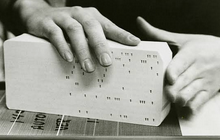
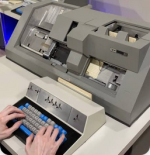
In college, we had a room full of card-punch machines for us to code our programs.
Then we'd take our card decks into a big room where people could come and line up to read their card-ed program decks into a queue to be run at some point on the mainframe.
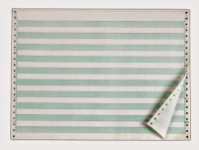
There were alphabetized stacks of wall bins where our green-bar fan-fold printouts would be delivered after our programs ran.
Mercutio
Fatwah on Western Digital
I've kind-of used a punch card system, but I was a VERY little kid when my mom was taking a FORTRAN class in about 1979. Putting the cards in the machine was "helping." Why did my mom have need to take a FORTRAN class? I have no idea, but I definitely remember being stuck in a room full of terminals a couple times a week when I was maybe four years old. I played with Star Wars people the whole time and one day somebody gave me a continuous feed print of Darth Vader that I probably still have in a box someplace, one of the reasons I remember that as well as I do.
jtr1962
0
My mother also had a computer course using punch cards when I was in grade school. No idea why as her major was sociology.I've kind-of used a punch card system, but I was a VERY little kid when my mom was taking a FORTRAN class in about 1979. Putting the cards in the machine was "helping." Why did my mom have need to take a FORTRAN class? I have no idea, but I definitely remember being stuck in a room full of terminals a couple times a week when I was maybe four years old. I played with Star Wars people the whole time and one day somebody gave me a continuous feed print of Darth Vader that I probably still have in a box someplace, one of the reasons I remember that as well as I do.
I had punch cards in college and high school, but both were already converting to terminals by then. I think only one section of the computer labs in college still used punch cards.
Mercutio
Fatwah on Western Digital
Maybe it's like college now, when everybody has to take a class in Excel and Powerpoint even though only the only application a college student is definitely going to use is a Word processor?
I've literally never made a slide deck.
I've literally never made a slide deck.
sedrosken
Florida Man
I make the occasional powerpoint and spreadsheet.
My first introduction to a computer was my Dad's NEC desktop packing a Pentium MMX 200 and 32MB of RAM, running Windows 95. I wouldn't see a Commodore 64 in anything but pictures until I was 15.
My first introduction to a computer was my Dad's NEC desktop packing a Pentium MMX 200 and 32MB of RAM, running Windows 95. I wouldn't see a Commodore 64 in anything but pictures until I was 15.
fb
0
I have used paper tape/ticker tape or what you call it, to transfer programs to a CNC-machine.
Those were the days...
Those were the days...

mubs
0
My first job after college was with a "data center" with an IBM 1401 mainframe. Card reader / punch, 600 LPM line printer, 4 x tape drives, 16k magnetic core memory. We programmed in Autocoder (assembler). We had pads on which we wrote the code in pencil. This was sent to the card punch room where staff there punched the code into cards and sent the card deck back. We sent this to the computer room and it was run when there was a few minutes free. If there was a fatal error, the system operators would provide a print-out of the memory contents (core dump). This made a very loud, characteristic, rhythmic, unmistakable noise, accompanied by groans from the programmer who caused it. We ran complex accounting and payroll software in that 16k of memory and 4 tape drives (no disk drives).Speaking of ancient history, has anyone else here used card-punch machines to punch in code (FORTRAN, in my case) into a deck of cards?
In college, we had a room full of card-punch machines for us to code our programs.
Then we'd take our card decks into a big room where people could come and line up to read their card-ed program decks into a queue to be run at some point on the mainframe.
There were alphabetized stacks of wall bins where our green-bar fan-fold printouts would be delivered after our programs ran.
I am ancient.
Mercutio
Fatwah on Western Digital
I knew a dude in college whose monitor died the last week of the semester, so he switched his pre-1.0 Linux system to output to a line printer. Computer monitors weren't just given away back then, but he was stubborn enough about it that he continued to work from that machine in spite of that minor hiccup, and that's the newest computer I've ever seen use a printer as primary output.
The same guy has spent the last ~30 years back-porting changes to the Linux kernel to that same 486. I'm not sure if he finally stopped or not since I haven't heard from him in a few years but his day job in no way involves coding. I think he does support and troubleshooting for a regional wireless ISP in Eastern Indiana.
The same guy has spent the last ~30 years back-porting changes to the Linux kernel to that same 486. I'm not sure if he finally stopped or not since I haven't heard from him in a few years but his day job in no way involves coding. I think he does support and troubleshooting for a regional wireless ISP in Eastern Indiana.